OTP SMS Explained: What It Is and Why Every Online Business Needs It
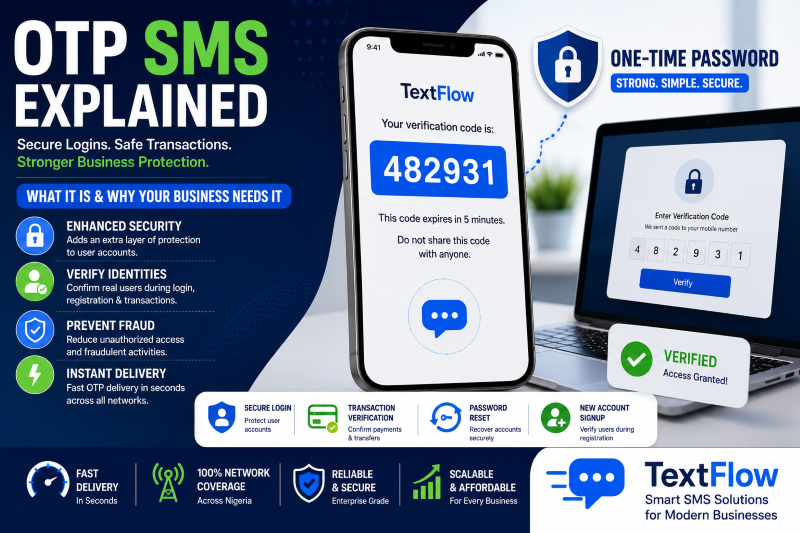
OTP SMS Explained: What It Is and Why Every Online Business Needs It
If you've ever logged into your bank account, made an online payment, or created an account on a website, you've probably received a text message containing a short verification code.
That code is called an OTP, which stands for One-Time Password.
OTP SMS has become one of the most widely used security tools for online businesses. It helps verify user identities, prevent fraud, and protect customer accounts from unauthorized access.
In this guide, we'll explain what OTP SMS is, how it works, and why every online business should use it.
What is an OTP?
An OTP (One-Time Password) is a unique numeric or alphanumeric code generated for a single login session or transaction.
Unlike a regular password, an OTP:
-
Can only be used once.
-
Expires after a short period.
-
Is generated automatically.
-
Adds an extra layer of security.
A typical OTP message looks like this:
"Your verification code is 483927. This code expires in 5 minutes. Do not share it with anyone."
Because each code is temporary, OTPs significantly reduce the risk of unauthorized access.
How Does OTP SMS Work?
The process is straightforward:
-
A user attempts to log in, register, or complete a sensitive action.
-
The system generates a unique verification code.
-
The code is sent instantly via SMS.
-
The user enters the code on the website or app.
-
The system verifies the code.
-
Access or the requested action is approved.
The entire process usually takes only a few seconds.
Why Businesses Use OTP SMS
1. Secure User Login
Passwords alone are no longer enough to protect user accounts.
OTP SMS adds an extra verification step, making it much harder for unauthorized users to gain access.
This approach is commonly known as Two-Factor Authentication (2FA).
2. Verify New Account Registrations
Businesses use OTP SMS to confirm that customers are registering with valid mobile numbers.
This helps reduce fake accounts, spam registrations, and abuse of online platforms.
3. Protect Financial Transactions
Banks, fintech companies, and payment providers use OTP SMS before processing important transactions.
Customers may be asked to verify:
-
Fund transfers
-
Withdrawals
-
Bill payments
-
Card changes
-
Profile updates
This extra verification protects both the customer and the business.
4. Password Reset Verification
When users forget their passwords, businesses can send an OTP instead of a temporary password.
Only the rightful owner of the registered phone number can complete the password reset.
5. Reduce Fraud
Fraudsters often obtain usernames and passwords through phishing attacks or data breaches.
Even if they know the password, they usually cannot complete the login without the OTP sent to the legitimate user's phone.
This greatly reduces fraudulent access.
Industries That Use OTP SMS
OTP SMS is widely used across many industries, including:
-
Banks
-
Fintech companies
-
E-commerce stores
-
Insurance companies
-
Healthcare providers
-
Logistics companies
-
Online marketplaces
-
Educational institutions
-
Government agencies
-
Telecommunications companies
-
Utility providers
-
SaaS platforms
Any organization that manages customer accounts or online transactions can benefit from OTP verification.
Benefits of OTP SMS
Stronger Security
OTP SMS provides an additional layer of protection beyond usernames and passwords.
Better Customer Trust
Customers feel more confident using services that protect their accounts.
Reduced Fraud Losses
Businesses can significantly reduce losses resulting from unauthorized access and fraudulent transactions.
Faster Verification
SMS messages are delivered quickly, allowing customers to complete verification in seconds.
Regulatory Compliance
Many industries require stronger authentication measures to protect customer information.
OTP SMS helps organizations meet these security expectations.
Best Practices for OTP SMS
To maximize security:
-
Generate random verification codes.
-
Keep OTPs short and easy to enter.
-
Set an expiration time of 3–10 minutes.
-
Allow only a limited number of verification attempts.
-
Never reuse old OTPs.
-
Never include sensitive account information in SMS messages.
-
Remind users not to share their OTP with anyone.
Common Mistakes to Avoid
Avoid these common security mistakes:
-
Using OTPs that never expire.
-
Allowing unlimited verification attempts.
-
Sending predictable verification codes.
-
Failing to encrypt communication between your application and the SMS provider.
-
Not monitoring suspicious verification activity.
Proper implementation is just as important as using OTPs.
SMS vs Email OTP
Many businesses ask whether OTPs should be sent by SMS or email.
SMS OTP
Advantages
-
Delivered directly to a mobile phone.
-
Usually read immediately.
-
Does not depend on email inboxes.
-
Ideal for urgent verification.
Email OTP
Advantages
-
Useful when phone numbers are unavailable.
-
Suitable for lower-risk actions.
For high-priority verification, many businesses prefer SMS because of its speed and reliability.
Why Businesses Choose TextFlow OTP API
TextFlow helps developers integrate secure OTP messaging into their applications with ease.
Our OTP SMS solution provides:
-
Fast message delivery
-
Reliable infrastructure
-
Secure REST API
-
High delivery success rates
-
Real-time delivery reports
-
Scalable architecture
-
Comprehensive API documentation
-
Responsive technical support
Whether you're building a banking platform, fintech application, e-commerce website, healthcare portal, or SaaS product, TextFlow provides the infrastructure you need for dependable OTP delivery.
Frequently Asked Questions
What does OTP stand for?
OTP stands for One-Time Password—a temporary verification code used to confirm a user's identity.
How long should an OTP remain valid?
Most businesses set OTP expiration times between 3 and 10 minutes, depending on the sensitivity of the transaction.
Is OTP SMS secure?
Yes. When implemented properly alongside secure application development practices, OTP SMS provides an additional layer of account protection.
Can startups use OTP SMS?
Absolutely. Startups, SMEs, and large enterprises all use OTP SMS to secure customer accounts and transactions.
Getting Started with TextFlow OTP SMS
Integrating OTP messaging with TextFlow is simple:
-
Create a free TextFlow account.
-
Verify your business profile.
-
Generate your API credentials.
-
Read our developer documentation.
-
Connect your application using our REST API.
-
Start sending secure OTP SMS in minutes.
Our technical team is available to support you throughout the integration process.
Conclusion
Cybersecurity is no longer optional for modern businesses. Whether you're protecting customer accounts, confirming transactions, or verifying new registrations, OTP SMS provides a fast, reliable, and effective way to strengthen security.
By implementing OTP verification, businesses reduce fraud, improve customer confidence, and create a safer digital experience.
If you're looking for a dependable OTP SMS provider in Nigeria, TextFlow offers secure APIs, fast delivery, competitive pricing, and scalable infrastructure designed for businesses of every size.
Create your free TextFlow account today and start protecting your users with reliable OTP SMS.